

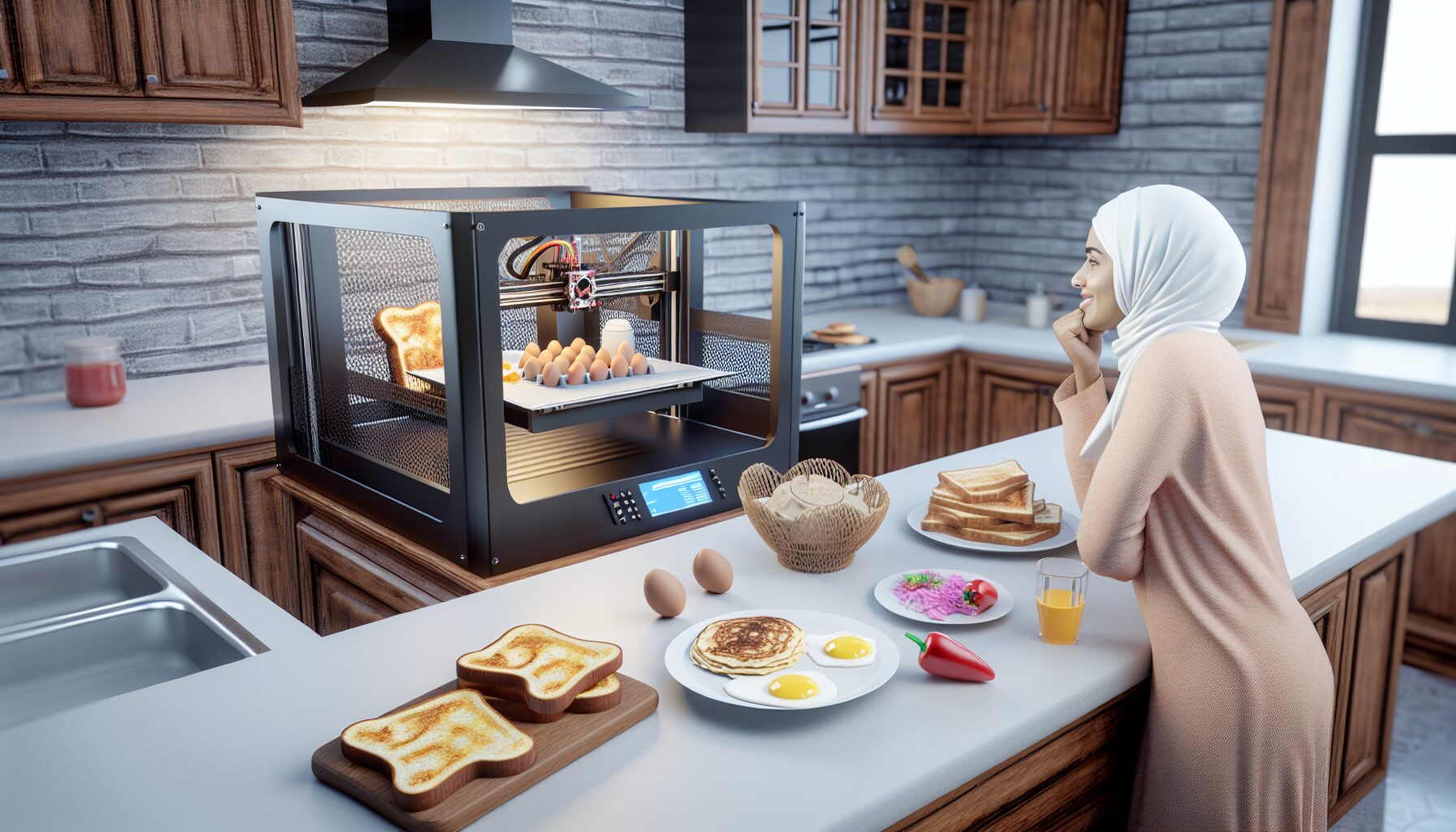
3D printing has already revolutionized industries from aerospace to healthcare, but now it’s heating up the kitchen. Researchers are exploring how 3D printers can be used to prepare and cook food—starting with the most important meal of the day: breakfast.
3D Printing Meets Culinary Innovation
Scientists at Columbia University have developed a prototype 3D printer capable of preparing and cooking food simultaneously. Unlike traditional food printers that only shape ingredients, this new system integrates lasers to cook the food as it’s being printed. The team demonstrated this by printing and cooking a seven-ingredient cheesecake, and more recently, a breakfast meal.
The printer uses a combination of paste-like ingredients—such as dough, cheese, and sauces—loaded into cartridges. As the printer deposits each layer, a laser cooks the food in real time. This method allows for precise control over cooking levels, textures, and even flavor distribution.
How 3D Food Printing Works
3D food printing typically involves extrusion-based technology, where edible pastes are pushed through a nozzle to build up layers of food. The Columbia team’s innovation lies in integrating a cooking mechanism—specifically, a blue laser that can cook food with pinpoint accuracy. This allows for the creation of complex, multi-layered dishes that are cooked internally as they are printed.
In the breakfast demonstration, the printer was used to prepare a meal that included eggs and other breakfast staples. The laser cooking process ensures that each component is cooked to the desired doneness, offering a level of precision that’s difficult to achieve with conventional cooking methods.
Potential Applications and Future of Food Printing
While the idea of printing your breakfast may sound futuristic, the implications are very real. 3D food printing could be a game-changer in several areas:
- Personalized Nutrition: Meals can be tailored to individual dietary needs, including calorie count, macronutrient ratios, and even flavor preferences.
- Food Sustainability: By using alternative ingredients like plant-based proteins or food waste, 3D printing could reduce the environmental impact of food production.
- Space Exploration: NASA has already explored 3D food printing for long-duration space missions, where traditional cooking isn’t feasible.
- Healthcare: Patients with specific dietary restrictions or swallowing difficulties could benefit from customized, easy-to-consume meals.
Despite its promise, 3D food printing still faces challenges. Ingredient preparation, printer maintenance, and consumer acceptance are all hurdles that need to be addressed before this technology becomes mainstream in home kitchens.
From Lab to Kitchen: What’s Next?
As the technology matures, we may see 3D food printers becoming more accessible to consumers. Companies like Natural Machines and Foodini are already developing commercial food printers aimed at restaurants and home users. The integration of cooking capabilities, like those demonstrated by Columbia University, could be the next big leap.
For now, 3D-printed breakfast remains a research project, but it’s a tantalizing glimpse into the future of food preparation. As additive manufacturing continues to evolve, it’s not just about building parts—it’s about building meals.
Source: Creative Bloq

