

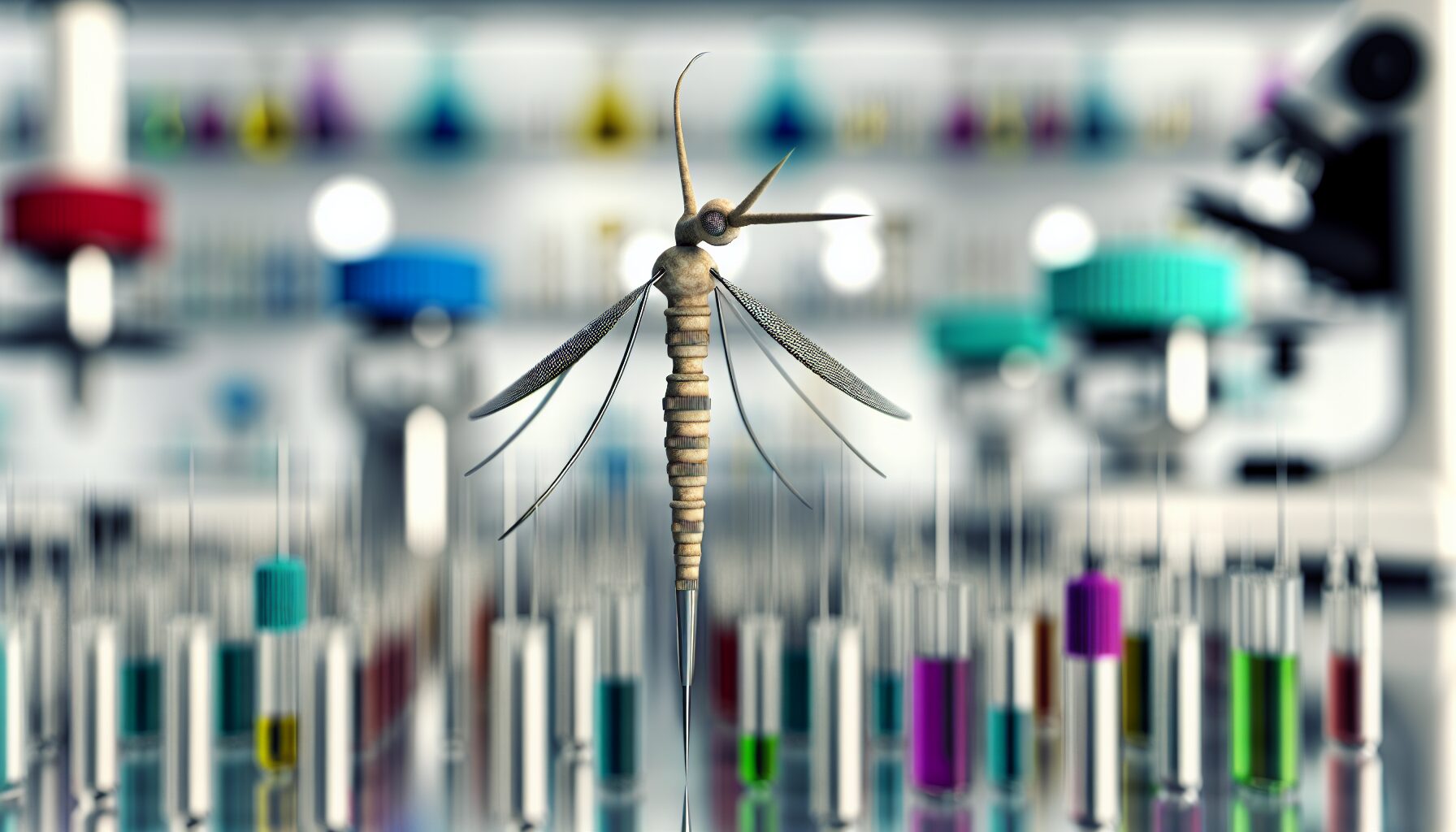
Nature has long been a source of inspiration for engineering breakthroughs, and the latest innovation in precision 3D printing is no exception. Drawing from the unique anatomy of a mosquito’s proboscis, researchers have developed a micro-needle that could significantly enhance the accuracy and control of micro-scale additive manufacturing and fluid delivery systems.
Biomimicry in 3D Printing: Learning from Mosquitoes
The mosquito’s proboscis is a marvel of natural engineering. Despite its tiny size, it can pierce human skin with minimal pain and extract blood efficiently. This is due to its complex structure, which includes multiple moving parts that vibrate and saw through tissue with remarkable precision. Scientists at the University of Hong Kong and the University of Electronic Science and Technology of China have replicated this mechanism to create a micro-needle capable of delivering fluids with unprecedented control.
The team’s design mimics the mosquito’s fascicle—a bundle of six needle-like structures that work together to penetrate skin. Their artificial version uses a similar multi-part configuration, enabling it to move in a controlled, oscillating motion. This allows the needle to pierce materials with minimal force, reducing damage and improving precision. The researchers believe this technology could be a game-changer for microfluidics and high-resolution 3D printing.
Precision Microfluidics and Additive Manufacturing Applications
One of the most promising applications of this mosquito-inspired micro-needle is in microfluidics, where precise control over fluid flow is essential. Traditional microfluidic systems often struggle with issues like clogging, inconsistent flow rates, and limited resolution. The new needle design addresses these challenges by enabling more accurate and consistent fluid delivery, even at extremely small scales.
In the realm of 3D printing, especially at the micro and nano scale, the ability to deposit materials with pinpoint accuracy is crucial. The researchers demonstrated that their needle could be used to extrude materials in a controlled manner, opening the door to new possibilities in bioprinting, electronics manufacturing, and the creation of intricate microstructures. The needle’s ability to operate with minimal force also means it can work with delicate materials without causing damage.
Technical Details and Performance
The artificial needle is constructed from a combination of soft and rigid materials, allowing it to replicate the flexibility and strength of the mosquito’s fascicle. It is driven by a piezoelectric actuator, which provides the oscillating motion needed for penetration and fluid delivery. The researchers tested the needle on various substrates, including soft gels and biological tissues, and found that it could deliver fluids with high precision and minimal resistance.
In one experiment, the team used the needle to extrude a hydrogel in a controlled pattern, demonstrating its potential for use in 3D bioprinting. The results showed that the needle could produce fine lines with consistent width and spacing, outperforming traditional extrusion methods. The researchers also noted that the needle’s design could be scaled down further, potentially enabling even finer resolution in future applications.
Future Outlook and Industry Impact
While the technology is still in the early stages of development, its potential impact on the 3D printing and microfluidics industries is significant. By enabling more precise control over material deposition and fluid flow, the mosquito-inspired needle could lead to new capabilities in medical device manufacturing, tissue engineering, and microelectronics.
Moreover, the use of biomimicry in engineering continues to demonstrate how nature’s designs can solve complex technical challenges. As researchers refine the needle’s design and explore new materials and actuation methods, we can expect to see further advancements in micro-scale additive manufacturing and fluidic systems.
Ultimately, this innovation underscores the importance of interdisciplinary research, combining biology, materials science, and mechanical engineering to push the boundaries of what’s possible in 3D printing technology.
Source: New Atlas

