

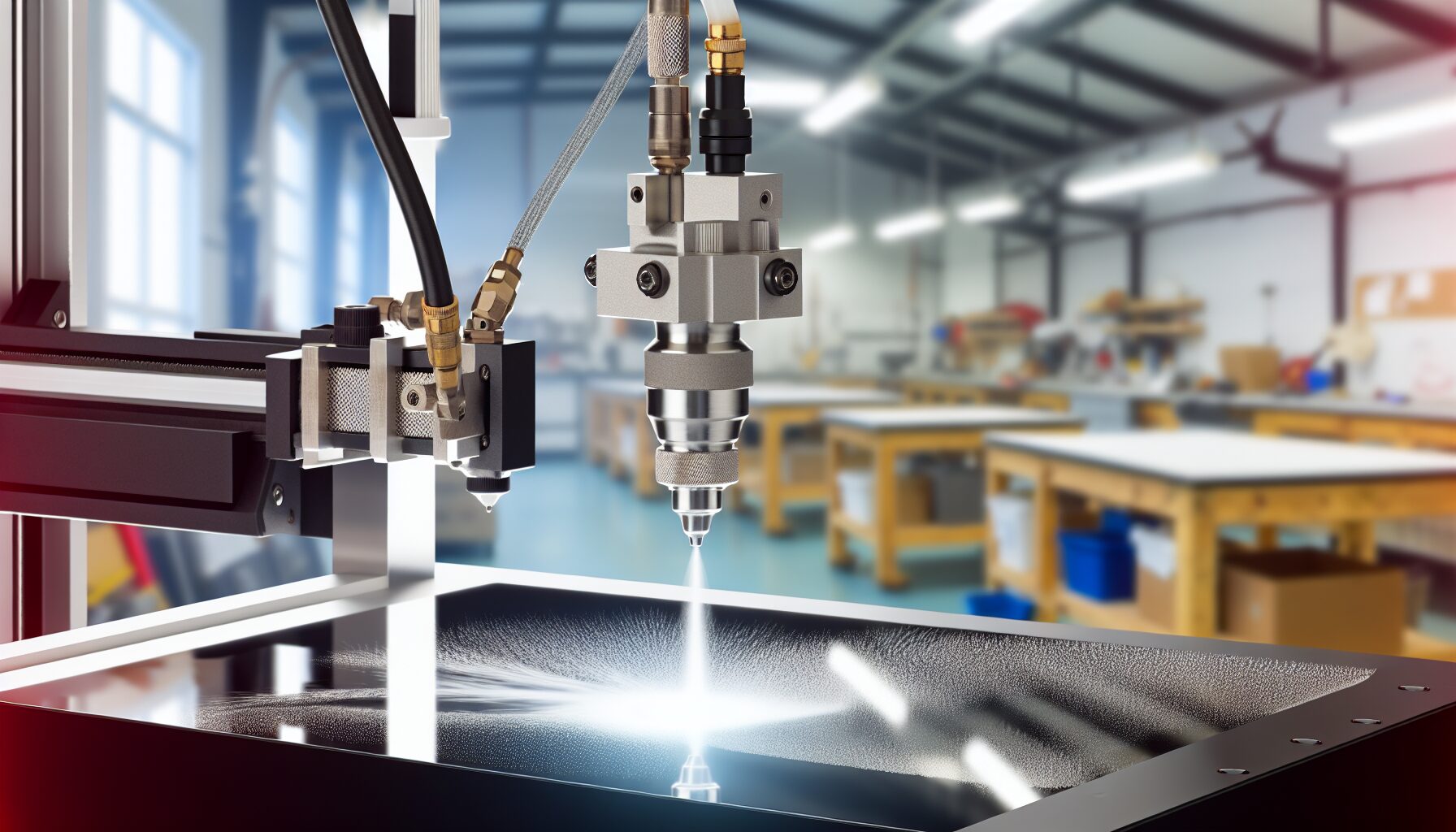
A new Kickstarter campaign is turning heads in the maker community by offering a unique way to cut metal using your existing 3D printer. Liquid Blade 3D is a compact, affordable electrochemical machining (ECM) toolhead that uses salt water and electricity to precisely cut through metal, opening up new possibilities for hobbyists and professionals alike.
How Liquid Blade 3D Works
Liquid Blade 3D is based on the principle of electrochemical machining (ECM), a non-contact process that removes metal by anodic dissolution. In simpler terms, it uses a conductive liquid—salt water in this case—and a low-voltage electric current to erode metal in a controlled manner. The process is similar to electroplating in reverse.
The Liquid Blade 3D toolhead mounts onto a standard 3D printer or CNC machine and connects to a power supply. As the toolhead moves over the metal surface, it delivers a stream of salt water and a small electric current, gradually dissolving the metal along a programmed path. This allows for precise, burr-free cuts without generating heat or mechanical stress, making it ideal for delicate or complex parts.
Compatible with Most 3D Printers
One of the most appealing aspects of Liquid Blade 3D is its compatibility with a wide range of desktop 3D printers and CNC machines. The developers have designed the system to be plug-and-play, requiring minimal setup. It works with common G-code commands, so users can generate toolpaths using standard slicing software or CAM tools.
The system includes a custom toolhead, a pump for circulating the salt water electrolyte, and a power supply. The Kickstarter campaign offers several pledge levels, including kits for DIY assembly and fully assembled units. The creators also provide open-source software and documentation to help users get started quickly.
Applications and Advantages of ECM in 3D Printing
Electrochemical machining has long been used in industrial settings for high-precision applications, such as aerospace and medical components. By bringing ECM to the desktop, Liquid Blade 3D enables makers to cut metals like stainless steel, titanium, and copper with high accuracy and minimal tool wear.
Unlike traditional machining methods, ECM does not produce heat-affected zones or mechanical deformation, which is especially useful for thin or intricate parts. It also eliminates the need for expensive tooling or abrasive materials. This makes it a cost-effective and accessible solution for prototyping, custom parts, and small-scale manufacturing.
Kickstarter Campaign and Future Outlook
The Liquid Blade 3D Kickstarter campaign launched with a modest funding goal and has already attracted significant interest from the maker and engineering communities. Backers can choose from various reward tiers, including early-bird discounts and educational kits for schools and makerspaces.
The team behind Liquid Blade 3D plans to continue developing the technology, with future updates aimed at improving speed, resolution, and material compatibility. If successful, this project could pave the way for a new class of hybrid manufacturing tools that combine additive and subtractive processes on the same desktop platform.
Source: All3DP

