

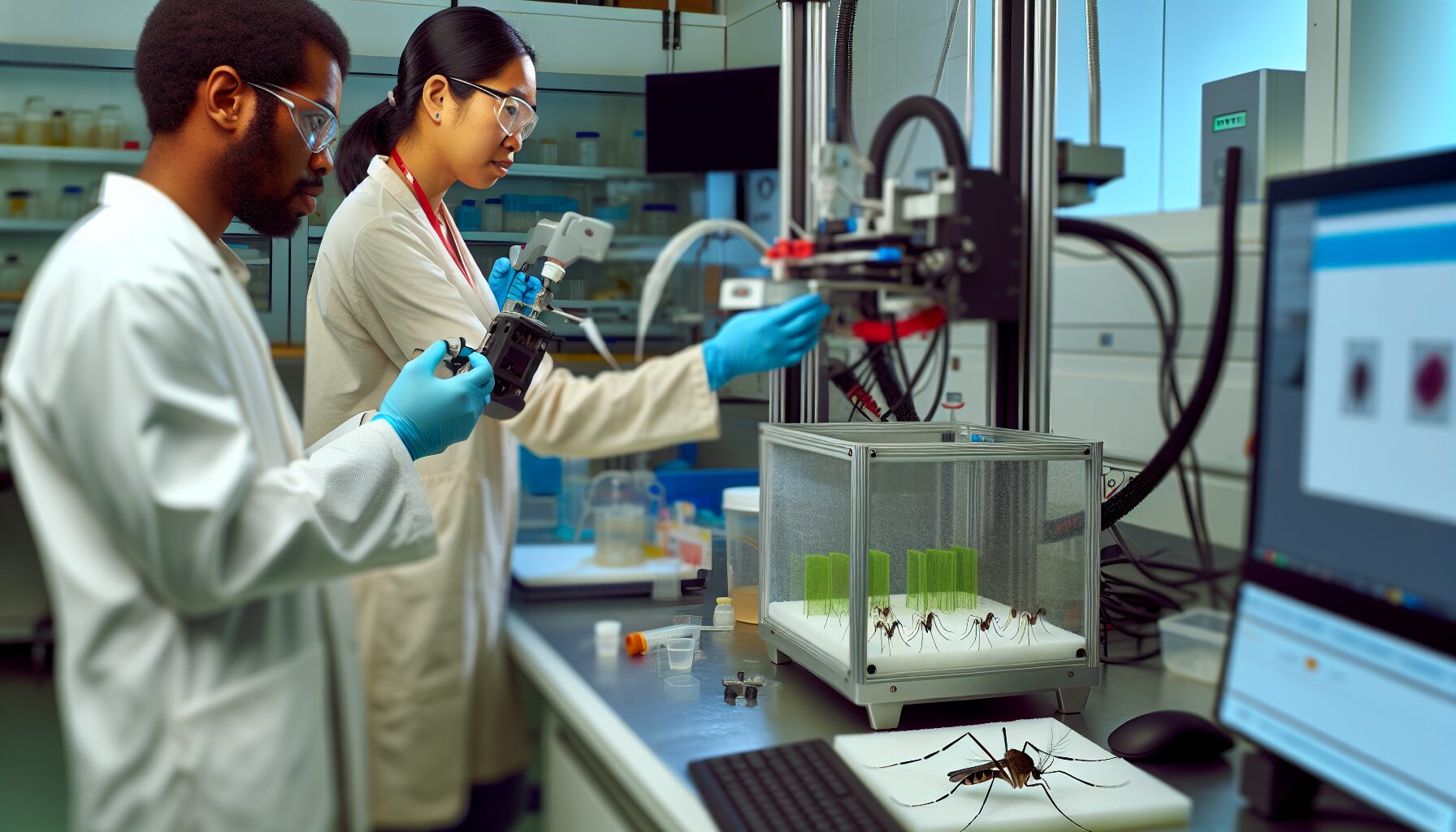
In a surprising twist of science and sustainability, researchers at Drexel University have discovered a novel use for a substance derived from mosquitoes that could significantly enhance 3D printing. This breakthrough not only opens new doors for bio-based materials in additive manufacturing but also marks a rare beneficial application for one of the world’s most notorious insects.
Innovative Use of Mosquito-Derived Melanin in 3D Printing
The Drexel team, led by Professor Christopher Li from the Department of Materials Science and Engineering, has been studying melanin extracted from mosquito eggs. Melanin, a natural pigment found in many organisms, is known for its unique chemical and physical properties, including UV protection, electrical conductivity, and metal-binding capabilities.
What makes this research stand out is the source of the melanin—mosquitoes. Specifically, the team harvested melanin from the eggs of Aedes aegypti, the mosquito species known for spreading diseases like Zika and dengue. The researchers discovered that this melanin has a unique structure that makes it particularly suitable for use in 3D printing applications.
By incorporating mosquito-derived melanin into polymer matrices, the team was able to create composite materials with enhanced mechanical and functional properties. These materials can be used in additive manufacturing processes to produce parts with improved durability, conductivity, and environmental resistance.
Why Mosquito Melanin?
Melanin is not a new material in scientific research, but the melanin found in mosquito eggs has a distinct nanostructure that sets it apart. According to Professor Li, this form of melanin is more uniform and easier to process than melanin from other sources. It also exhibits superior performance in terms of thermal stability and electrical conductivity.
“We were surprised to find that the melanin from mosquito eggs had such a well-organized nanostructure,” said Li. “This makes it an excellent candidate for integration into advanced materials, especially in the field of 3D printing.”
The team used a process called solution casting to blend the melanin with polymers, creating a printable filament. This filament was then used in fused deposition modeling (FDM), one of the most common 3D printing techniques. The resulting prints demonstrated improved strength and conductivity compared to standard polymer prints.
Potential Applications and Environmental Impact
The implications of this discovery are far-reaching. The enhanced properties of mosquito-melanin composites could be useful in a variety of industries, including electronics, aerospace, and biomedical engineering. For example, the material’s conductivity could be leveraged to print flexible electronic circuits or sensors directly into components.
Moreover, the use of a bio-derived material aligns with growing efforts to make 3D printing more sustainable. Traditional 3D printing materials, such as ABS and PLA, are either petroleum-based or require significant energy to produce. By contrast, melanin is a naturally occurring substance that can be harvested with minimal environmental impact—especially when sourced from a pest species like mosquitoes.
“This is one of the first times we’ve found a beneficial use for mosquitoes,” said Li. “It’s exciting to think that something typically seen as a nuisance could help us build better, more sustainable materials.”
Challenges and Future Research
While the results are promising, the researchers acknowledge that there are still challenges to overcome. One major hurdle is scaling up the production of mosquito melanin. Currently, the extraction process is labor-intensive and yields small quantities. The team is exploring ways to synthesize the melanin or find alternative sources with similar properties.
Another area of ongoing research is optimizing the composite formulation to maximize performance while maintaining printability. The team is also investigating how the material behaves under different environmental conditions and stressors, which is crucial for real-world applications.
Despite these challenges, the discovery represents a significant step forward in the development of bio-based materials for additive manufacturing. It also highlights the potential of looking to nature—even to its most reviled creatures—for innovative solutions to modern engineering problems.
As 3D printing continues to evolve, the integration of sustainable, high-performance materials like mosquito-derived melanin could play a key role in shaping the future of manufacturing.
Source: phillyvoice.com

