

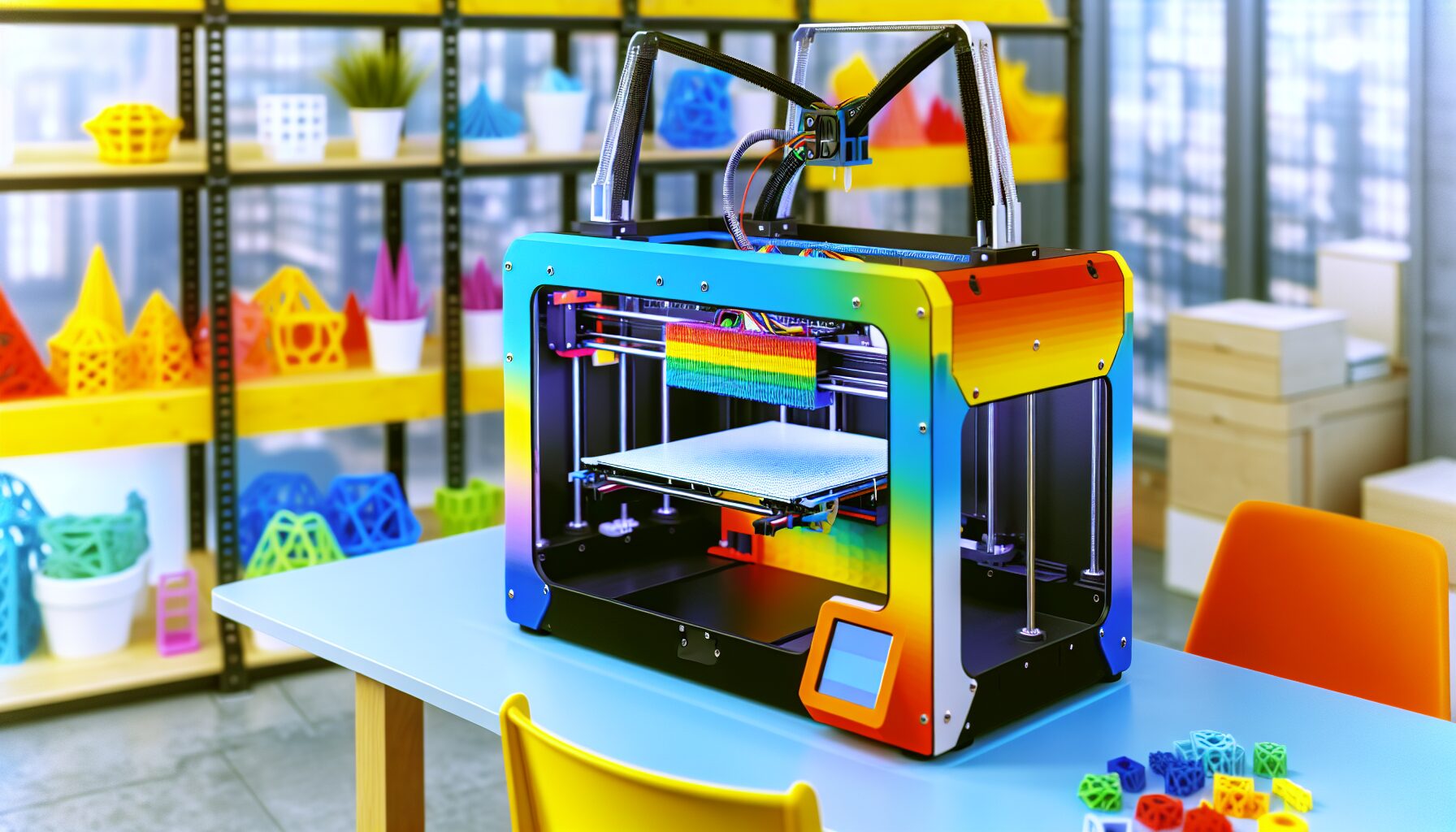
Multicolor 3D printing has come a long way, and 2025 is shaping up to be a banner year for vibrant, multi-hued creations. Whether you’re a hobbyist, designer, or educator, the latest multicolor 3D printers offer more flexibility, better color fidelity, and easier workflows than ever before.
What Is Multicolor 3D Printing?
Multicolor 3D printing refers to the ability to print objects in more than one color during a single print job. This can be achieved through various methods, including multiple extruders, filament switching, or advanced mixing hotends. The goal is to produce colorful, detailed models without the need for post-processing or painting.
There are three main approaches to multicolor 3D printing:
- Multi-material extruders: These use multiple filament inputs to switch or blend colors.
- Tool changers: These swap entire print heads to use different filaments.
- Palette systems: External devices that splice filaments before feeding them into a single extruder.
Top Multicolor 3D Printers of 2025
Here are the best multicolor 3D printers available in 2025, based on print quality, ease of use, and value for money.
1. Bambu Lab X1-Carbon with AMS
The Bambu Lab X1-Carbon, paired with the Automatic Material System (AMS), is a standout for its speed and color capabilities. The AMS allows up to four filaments to be loaded and automatically switched during printing. With a CoreXY motion system and AI-powered features like spaghetti detection and vibration compensation, the X1-Carbon delivers high-quality multicolor prints with minimal fuss.
Pros: Fast printing, excellent color transitions, smart features
Cons: AMS adds to the cost, limited to four colors per AMS unit
2. Prusa MK4 with MMU3
Prusa’s MK4, when combined with the Multi-Material Upgrade 3 (MMU3), supports up to five filaments. The MMU3 has been redesigned for better reliability and easier setup. While slower than some competitors, the MK4’s print quality and open-source ecosystem make it a favorite among enthusiasts.
Pros: Reliable, open-source, excellent community support
Cons: Slower print speeds, more complex setup
3. Bambu Lab P1S with AMS
The P1S is a more affordable alternative to the X1-Carbon, offering similar multicolor capabilities when paired with the AMS. It lacks some of the premium features like LIDAR scanning but still delivers fast, high-quality prints in up to four colors.
Pros: Great value, fast printing, AMS compatibility
Cons: Fewer smart features than X1-Carbon
4. Prusa XL with Tool Changer
The Prusa XL is a large-format CoreXY printer that supports up to five independent tool heads. This allows for true multi-material and multicolor printing without filament splicing. It’s ideal for professionals and educators who need precision and flexibility.
Pros: True multi-material support, large build volume
Cons: Expensive, still in limited release
5. Palette 3 Pro with Compatible Printers
Mosaic’s Palette 3 Pro is an external filament splicer that works with most single-extruder printers. It can combine up to eight filaments into one line, enabling multicolor prints without modifying your printer. While setup can be tricky, it’s a versatile option for those with existing hardware.
Pros: Works with many printers, up to 8 colors
Cons: Complex calibration, slower print speeds
Choosing the Right Multicolor 3D Printer
When selecting a multicolor 3D printer, consider the following factors:
- Number of colors: How many filaments can the printer handle at once?
- Ease of use: Is the setup and operation user-friendly?
- Print speed: Does the printer maintain speed with multicolor jobs?
- Software support: Are slicing and color assignment tools intuitive?
- Community and support: Is there a strong user base and manufacturer support?
Applications of Multicolor 3D Printing
Multicolor 3D printing opens up new possibilities across various fields:
- Education: Create engaging, color-coded models for STEM learning.
- Product design: Prototype with realistic color schemes.
- Miniatures and cosplay: Print detailed, colorful models without painting.
- Signage and branding: Produce vibrant logos and displays.
As the technology matures, expect even more accessible and powerful multicolor solutions in the coming years.
Source: Tom’s Hardware

