

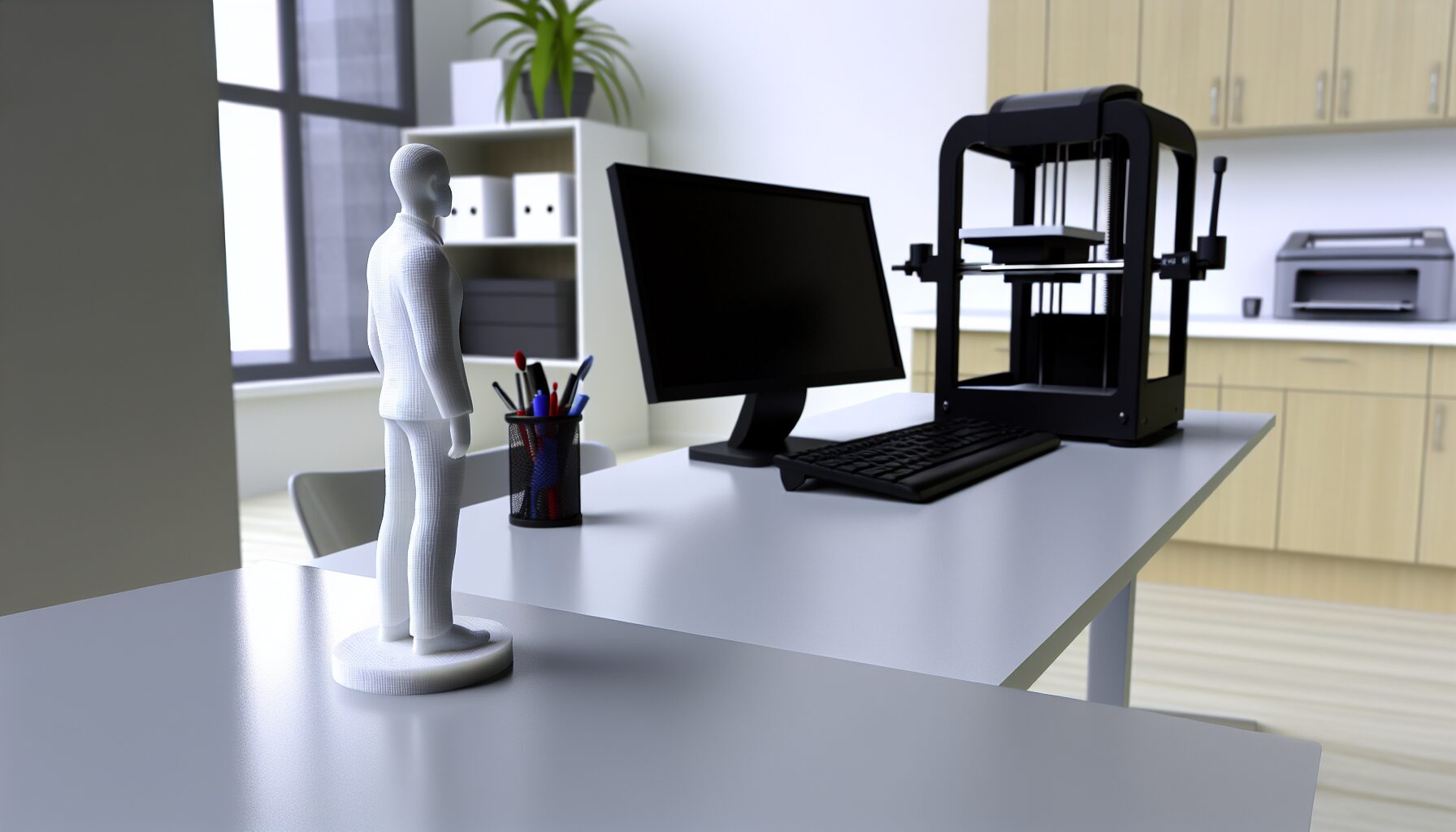
Ever wondered what it would be like to hold a tiny version of yourself in your hand? Thanks to the latest in AI and 3D printing technology, that’s no longer just a sci-fi fantasy. In a recent experiment, a tech journalist set out to create a miniature figurine of himself—and the results were surprisingly lifelike.
Using AI to Create a 3D Model
The journey began with a smartphone and an AI-powered app called Luma AI. This app uses photogrammetry—a process that stitches together multiple images to create a 3D model. The author took a series of photos from different angles, allowing the app to generate a detailed 3D scan of his head and upper torso. The result was a surprisingly accurate digital twin, complete with facial features and hair texture.
While Luma AI is user-friendly, it’s not perfect. The app struggled with certain lighting conditions and background clutter, which required some trial and error. However, once the scan was complete, the model was exported in a format compatible with 3D printing software.
Preparing the Model for 3D Printing
Next came the editing phase. The 3D model was imported into Blender, a free and open-source 3D modeling tool. Here, the author cleaned up the scan, filled in any holes, and adjusted the mesh to make it printable. This step is crucial, as raw scans often contain imperfections that can cause issues during printing.
Once the model was cleaned up, it was scaled down to a height of about 3 inches—perfect for a desktop figurine. The file was then exported as an STL file, the standard format for 3D printing.
Choosing the Right 3D Printer and Material
For the actual printing, the author used a resin-based 3D printer, which offers higher resolution than traditional FDM (fused deposition modeling) printers. Resin printers are ideal for small, detailed objects like figurines because they can capture fine features such as facial expressions and hair strands.
The print took several hours to complete, followed by a post-processing phase that included washing the model in isopropyl alcohol and curing it under UV light. The final result was a smooth, detailed miniature bust that looked remarkably like the original scan.
Applications and Future Potential
While this project was done for fun, the implications of combining AI and 3D printing are far-reaching. From personalized gifts to custom avatars for virtual reality, the ability to quickly and affordably create lifelike models opens up a world of possibilities. Businesses are already exploring similar technologies for custom action figures, medical prosthetics, and even digital fashion.
As AI scanning tools become more accurate and accessible, and as 3D printers continue to improve in resolution and speed, we can expect to see more people experimenting with personalized 3D models. Whether for novelty or utility, the fusion of AI and additive manufacturing is making it easier than ever to bring digital creations into the physical world.
Source: ZDNET

