

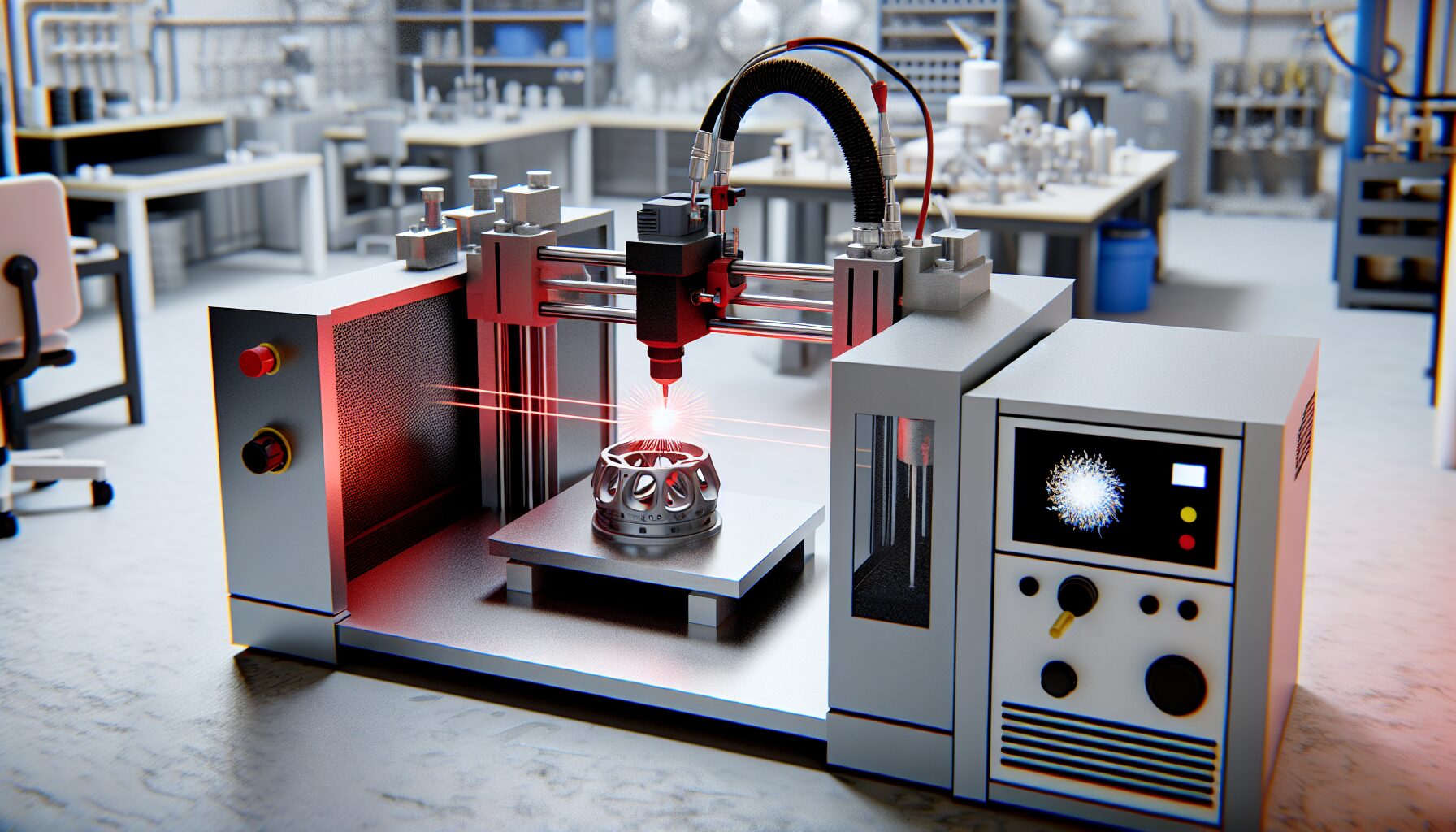
In a breakthrough that could reshape the future of advanced manufacturing, researchers have discovered that the speed of a laser during 3D printing can directly influence the atomic structure of high-entropy alloys (HEAs). This finding opens new possibilities for customizing material properties at the atomic level, offering unprecedented control over strength, ductility, and performance.
Laser Speed and Atomic Structure in Additive Manufacturing
High-entropy alloys are a class of materials composed of five or more elements in roughly equal proportions. Unlike traditional alloys, which typically have one dominant element, HEAs derive their unique properties from the complex interactions among multiple elements. These materials are known for their exceptional strength, corrosion resistance, and thermal stability, making them ideal for aerospace, defense, and energy applications.
In the recent study, scientists from the University of Wisconsin–Madison and the U.S. Department of Energy’s Oak Ridge National Laboratory used laser powder bed fusion (LPBF)—a common metal 3D printing technique—to fabricate HEAs. They discovered that by adjusting the laser scan speed, they could control the cooling rate of the molten metal, which in turn influenced the atomic arrangement of the alloy.
Faster laser speeds led to rapid cooling, resulting in a more disordered atomic structure. Slower speeds allowed atoms more time to arrange themselves into a more ordered configuration. This ability to tune atomic structure through process parameters is a significant advancement in additive manufacturing, as it allows engineers to tailor material properties without changing the alloy’s composition.
Implications for Material Design and Performance
The ability to manipulate atomic structure during the 3D printing process has far-reaching implications. For instance, a more disordered atomic structure can enhance strength and hardness, while a more ordered structure may improve ductility and toughness. This level of control enables the design of materials that are optimized for specific applications, such as lightweight yet strong components for aerospace or wear-resistant parts for industrial machinery.
Moreover, this discovery could lead to the development of functionally graded materials—components with varying properties across their volume. By simply adjusting the laser speed during printing, manufacturers could create parts with hard exteriors and tough interiors, or vice versa, without the need for multiple materials or post-processing steps.
Advanced Characterization and Simulation Techniques
To understand the relationship between laser speed and atomic structure, the research team employed a combination of experimental and computational methods. They used advanced electron microscopy to observe atomic arrangements and molecular dynamics simulations to model how atoms behave under different cooling rates.
These techniques revealed that the atomic structure of HEAs is highly sensitive to thermal history. The simulations showed that rapid cooling traps atoms in a high-energy, disordered state, while slower cooling allows them to settle into a lower-energy, more ordered configuration. This insight provides a foundation for predictive modeling of material behavior based on processing parameters.
Future Directions in 3D Printing of High-Entropy Alloys
This research marks a significant step toward the rational design of materials through additive manufacturing. By integrating process control with atomic-level understanding, engineers can now design and fabricate components with tailored properties for demanding applications.
Looking ahead, the team plans to explore how other process parameters—such as laser power, hatch spacing, and layer thickness—affect atomic structure and material performance. They also aim to investigate a broader range of HEA compositions to identify optimal combinations for specific use cases.
As additive manufacturing continues to evolve, the ability to fine-tune materials at the atomic level will be a key enabler of next-generation technologies. From jet engines to nuclear reactors, the materials of the future will be built not just from the ground up, but from the atom up.
Source: Tech Xplore

