

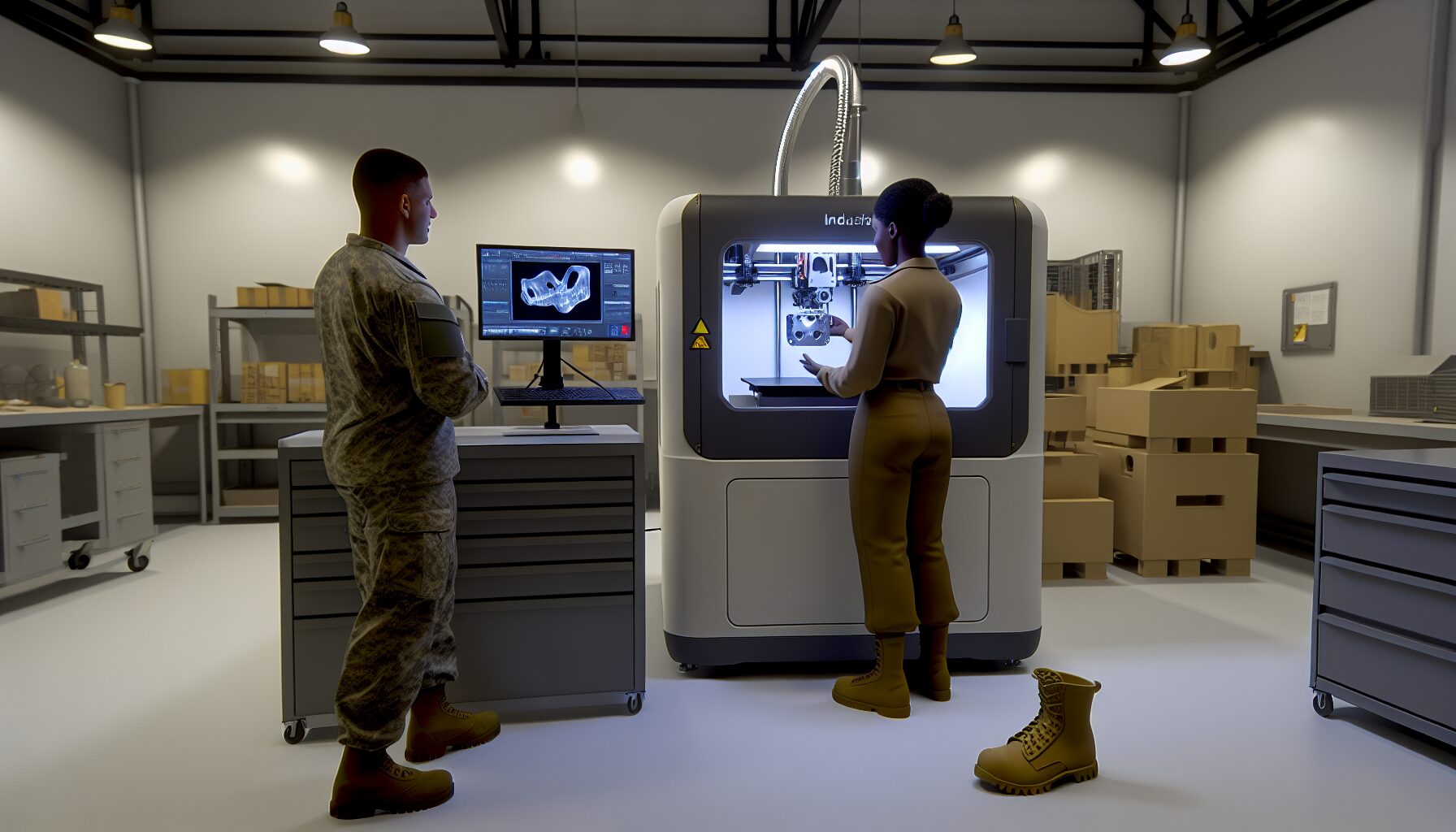
Defense 3D printing has quietly moved from experimental labs into real-world operations. What began as small research projects is now evolving into a strategic capability that can reshape how militaries design, produce, and sustain equipment around the globe.
How 3D Printing Is Transforming Defense Manufacturing
In the defense sector, 3D printing—more formally known as additive manufacturing (AM)—is no longer just a curiosity. It is becoming a practical tool for solving long-standing problems in logistics, maintenance, and rapid prototyping. Instead of waiting weeks or months for a spare part to arrive through traditional supply chains, units can increasingly print components on demand, closer to where they are needed.
This shift is driven by several converging trends:
- Maturing technologies: Metal and polymer 3D printers have become more reliable, repeatable, and industrially robust.
- Digital design workflows: Widespread use of CAD, simulation, and digital twins makes it easier to design and validate parts for additive manufacturing.
- Operational pressure: Modern conflicts and dispersed operations demand faster, more flexible ways to keep equipment in the fight.
- Policy and funding: Defense ministries and agencies are now explicitly funding AM programs and writing doctrine around their use.
As a result, defense 3D printing is moving from isolated pilot projects to coordinated, scaled deployments that touch everything from aircraft sustainment to naval logistics and ground vehicle repair.
From Lab to Field: The Journey of Defense 3D Printing
The path from research to deployment in defense 3D printing typically follows a recognizable pattern. Understanding this journey helps explain why some programs scale successfully while others stall.
Early Research and Prototyping
Most defense AM efforts begin in research labs, innovation hubs, or partnerships with universities and industry. At this stage, the focus is on proving what is technically possible:
- Printing demonstration parts to show feasibility.
- Exploring new materials, such as high-temperature polymers or advanced metal alloys.
- Developing design guidelines for lightweight, topology-optimized components.
- Testing how printed parts behave under load, temperature, and fatigue.
These early projects often target non-critical components—brackets, housings, covers, or training aids—where the risk of failure is low. The goal is to build confidence in the technology and gather data on performance, cost, and lead time.
Qualification, Certification, and Standards
Scaling defense 3D printing requires more than just technical success. Parts used on aircraft, ships, and armored vehicles must meet strict safety and performance standards. This is where qualification and certification come in.
Defense organizations work with regulators, OEMs, and standards bodies to:
- Define material specifications for AM powders and filaments.
- Establish process parameters and quality controls for each printer and material combination.
- Develop inspection and non-destructive testing (NDT) methods tailored to printed parts.
- Create documentation and traceability requirements for digital part files and build records.
In many cases, the qualification process focuses on families of parts rather than one-off approvals. Once a material, machine, and process window are qualified, multiple similar components can be approved more quickly. This is essential for scaling, because it avoids redoing the entire certification process for every new part.
Pilot Programs and Operational Experiments
After initial qualification, defense organizations typically run pilot programs in real operational environments. These pilots test not only the technology, but also the workflows, training, and logistics needed to support AM at scale.
Common pilot scenarios include:
- Deployed maintenance units equipped with ruggedized polymer printers to produce non-critical spares.
- Shipboard 3D printing labs that can fabricate replacement parts during long deployments.
- Airbase AM cells focused on aircraft sustainment, tooling, and ground support equipment.
- Centralized AM centers that handle more complex metal parts and feed a wider network of users.
These pilots reveal practical issues: how to manage digital part libraries, how to train operators, how to integrate AM into existing maintenance procedures, and how to handle cybersecurity for design files. Lessons learned here shape the doctrine and policies that will govern broader deployment.
Scaling Up: Networks, Doctrine, and Industrial Integration
Once pilots demonstrate value, the focus shifts to scaling. This is where defense 3D printing moves from isolated success stories to a systemic capability.
Key elements of scale-up include:
- Distributed AM networks: Connecting multiple printers across bases, ships, and depots into a coordinated system with shared digital inventories.
- Digital part libraries: Curated, secure repositories of validated 3D models, build parameters, and quality documentation.
- Standardized training: Formal curricula for AM operators, engineers, and maintainers, often with certification pathways.
- Industrial partnerships: Working with OEMs and AM service providers to ensure interoperability, IP protection, and supply chain resilience.
- Doctrine and policy: Clear rules on when and how to use AM, who owns the data, and how to manage risk.
At this stage, additive manufacturing is no longer a niche capability. It becomes embedded in planning, budgeting, and operations, with measurable impact on readiness and lifecycle costs.
Key 3D Printing Technologies in Defense Applications
Defense 3D printing spans a wide range of technologies and materials, each suited to different mission needs. Understanding these technologies helps explain where and how they are being deployed.
Polymer 3D Printing for Rapid, Lightweight Parts
Polymer-based 3D printing is often the entry point for defense organizations because the machines are relatively affordable, easier to operate, and well-suited to non-critical components.
Common polymer AM technologies include:
- Fused Filament Fabrication (FFF/FDM): Widely used for brackets, covers, housings, and training aids. Materials range from basic PLA and ABS to high-performance polymers like PEI (ULTEM) and PEEK.
- Stereolithography (SLA) and DLP: Resin-based systems that produce high-detail parts, often used for prototypes, molds, and small precision components.
- Selective Laser Sintering (SLS): Powder-based polymer printing that can produce strong, complex geometries without support structures, ideal for ducting, enclosures, and functional prototypes.
In defense settings, polymer printers are used for:
- Custom tools and jigs for maintenance and assembly.
- Replacement knobs, clips, and covers that are otherwise hard to source.
- Ergonomic grips and mounts for equipment.
- Training models and mock-ups for mission rehearsal.
Because many of these parts are non-structural, the qualification burden is lower, making polymer AM a fast way to demonstrate value and build user familiarity.
Metal Additive Manufacturing for Structural and High-Performance Parts
Metal 3D printing is where defense organizations see some of the most transformative potential, particularly for aerospace and high-performance applications. However, it also carries higher technical and regulatory complexity.
Key metal AM technologies include:
- Laser Powder Bed Fusion (LPBF): A laser selectively melts metal powder layer by layer. Used for complex, high-strength parts in titanium, aluminum, nickel superalloys, and stainless steels.
- Electron Beam Powder Bed Fusion (EB-PBF): Similar to LPBF but using an electron beam, often for titanium components in aerospace and defense.
- Directed Energy Deposition (DED): Metal powder or wire is fed into a melt pool created by a laser or electron beam. Useful for large repairs, adding features to existing parts, or building near-net-shape components.
- Binder Jetting and Sintering: Metal powder is bound with a liquid binder and later sintered. Attractive for higher throughput and lower cost per part in some applications.
Defense use cases for metal AM include:
- Lightweight, topology-optimized brackets and structural components for aircraft and UAVs.
- Heat exchangers and thermal management components with complex internal channels.
- Engine and turbine components where weight and performance are critical.
- Repair and refurbishment of high-value parts that would otherwise be scrapped.
Because these parts often operate in safety-critical environments, they require rigorous qualification, process control, and inspection. This is where close collaboration between defense agencies, OEMs, and AM vendors is essential.
Hybrid and Emerging Additive Manufacturing Approaches
Beyond traditional polymer and metal systems, defense organizations are exploring hybrid and emerging AM technologies that combine multiple processes or push into new material domains.
Examples include:
- Hybrid CNC–AM machines that can print and then mill parts in a single setup, improving surface finish and dimensional accuracy.
- Large-format additive systems for printing vehicle structures, shelters, or infrastructure components.
- Multi-material printing that combines conductive, structural, and insulating materials in a single build, enabling embedded electronics.
- Ceramic and refractory AM for high-temperature applications such as missile components or thermal protection systems.
These technologies are still in earlier stages of adoption but point toward a future where additive manufacturing is deeply integrated into defense design and production ecosystems.
Real-World Use Cases: 3D Printing in Defense Operations
To understand the impact of defense 3D printing, it helps to look at concrete use cases where additive manufacturing has already changed how militaries operate.
On-Demand Spare Parts and Supply Chain Resilience
One of the most compelling applications of AM in defense is on-demand production of spare parts. Traditional supply chains for military equipment are complex, global, and often slow. Many platforms remain in service for decades, long after original suppliers have moved on or tooling has been retired.
By digitizing spare parts and printing them when and where they are needed, defense organizations can:
- Reduce inventory costs and warehousing requirements.
- Shorten lead times from months to days or even hours.
- Mitigate risks from disrupted supply chains or geopolitical tensions.
- Extend the life of legacy platforms by replacing obsolete components.
In practice, this might mean a deployed unit printing a broken bracket for a vehicle, a ship’s crew fabricating a replacement valve housing, or an airbase producing a custom tool to service an aging aircraft. Each individual part may be small, but the cumulative effect on readiness can be significant.
Rapid Prototyping and Design Iteration
Defense R&D programs increasingly rely on 3D printing for rapid prototyping. Instead of waiting weeks for machined parts, engineers can print multiple design iterations in a matter of days, test them, and refine the design.
This accelerates innovation in areas such as:
- Unmanned aerial and ground systems.
- Sensor housings and mounts.
- Human–machine interfaces and ergonomic equipment.
- Experimental weapons and countermeasure systems.
By shortening development cycles, additive manufacturing helps defense organizations respond more quickly to emerging threats and operational needs.
Customized Equipment and Soldier-Centric Design
Another advantage of 3D printing is the ability to customize equipment for specific missions, environments, or individual users. In defense contexts, this can translate into:
- Custom-fit protective gear, such as helmet padding or body armor inserts.
- Mission-specific mounts and adapters for sensors, cameras, or communications gear.
- Ergonomic grips and controls tailored to individual soldiers.
- Specialized packaging and transport fixtures for sensitive equipment.
Because AM does not require new tooling for each variation, customization becomes economically viable even at low volumes. This aligns well with the diverse and rapidly changing needs of modern military operations.
Maintenance, Repair, and Overhaul (MRO)
Maintenance, repair, and overhaul activities are a major cost driver in defense budgets. Additive manufacturing offers new ways to reduce downtime and extend the life of high-value assets.
Examples include:
- Repairing worn or damaged parts using DED or similar processes to add material only where needed.
- Printing replacement components for ground support equipment and tooling that would otherwise be expensive to source.
- Creating inspection fixtures and gauges tailored to specific platforms.
By integrating AM into MRO workflows, defense organizations can improve availability of critical systems while reducing reliance on long, fragile supply chains.
Challenges and Considerations in Scaling Defense 3D Printing
Despite its promise, scaling 3D printing in defense is not straightforward. Several technical, organizational, and policy challenges must be addressed to move from isolated successes to a robust, enterprise-wide capability.
Qualification, Certification, and Risk Management
Safety-critical applications demand rigorous assurance that printed parts will perform as intended. This requires:
- Stable, repeatable processes across different machines and locations.
- Comprehensive material characterization and process monitoring.
- Standardized inspection and testing protocols.
- Clear criteria for when AM is appropriate and when traditional manufacturing is preferred.
Balancing innovation with risk management is a constant tension. Move too slowly, and the benefits of AM are delayed; move too quickly, and there is a risk of failures in critical systems. Successful programs typically start with lower-risk applications and gradually expand as confidence and data accumulate.
Digital Thread, Data Management, and Cybersecurity
At the heart of defense 3D printing is data: CAD models, build parameters, material records, and inspection results. Managing this data securely and effectively is essential for scale.
Key issues include:
- Digital thread: Maintaining traceability from original design through manufacturing, deployment, and maintenance.
- Access control: Ensuring that only authorized users can view, modify, or print sensitive designs.
- Cybersecurity: Protecting digital part libraries from tampering, theft, or sabotage.
- Interoperability: Enabling different systems and organizations to share data without losing fidelity or context.
Because many defense parts are sensitive or classified, the stakes are high. Robust digital infrastructure and security practices are as important as the printers themselves.
Workforce, Training, and Culture
Scaling defense 3D printing is as much a human challenge as a technical one. Operators, engineers, maintainers, and decision-makers all need to understand what AM can—and cannot—do.
Successful programs invest in:
- Formal training for AM operators and technicians.
- Design-for-additive-manufacturing (DfAM) education for engineers.
- Awareness training for commanders and logisticians on when to leverage AM.
- Cross-functional teams that bridge engineering, logistics, IT, and operations.
Cultural factors also matter. In some organizations, there may be resistance to new methods that challenge established supply chains or maintenance practices. Demonstrating clear, measurable benefits—such as reduced downtime or cost savings—helps build support.
Industrial Base and Intellectual Property
Defense 3D printing does not exist in isolation; it is part of a broader industrial ecosystem that includes OEMs, suppliers, and service providers. Scaling AM requires careful attention to:
- Intellectual property (IP): Negotiating rights to print parts originally designed by OEMs, and defining who owns new designs created in the field.
- Supply chain roles: Determining when to print in-house versus using external AM service bureaus.
- Standardization: Aligning on file formats, material specifications, and quality standards across the ecosystem.
Done well, additive manufacturing can strengthen the defense industrial base by creating new opportunities for suppliers and enabling more flexible, resilient production. Done poorly, it can create friction and uncertainty that slows adoption.
The Future of Defense 3D Printing: From Experiments to Essential Capability
As defense 3D printing continues to mature, its role is shifting from experimental add-on to essential infrastructure. Several trends are likely to shape the next phase of scale-up:
- Deeper integration with digital engineering: AM will be tightly linked with model-based systems engineering, simulation, and digital twins, enabling designs that are optimized from the start for additive production.
- More autonomous and deployable systems: Rugged, semi-autonomous printers could operate in austere environments with minimal human intervention, supporting dispersed and expeditionary operations.
- Lifecycle-wide impact: From initial design through sustainment and eventual disposal, additive manufacturing will influence how defense platforms are conceived, built, and maintained.
- Policy and doctrine codification: As experience accumulates, formal doctrine, standards, and best practices will solidify, making AM a routine part of defense planning.
The journey from research to deployment is not linear, and not every experiment will scale. But the direction of travel is clear: additive manufacturing is becoming a strategic enabler for modern defense forces, reshaping how they think about logistics, readiness, and technological advantage.
As militaries continue to invest in 3D printing technologies, the focus will increasingly shift from asking whether AM works to deciding where it delivers the greatest operational value—and how to integrate it seamlessly into the complex machinery of defense.
Source: Forbes

