

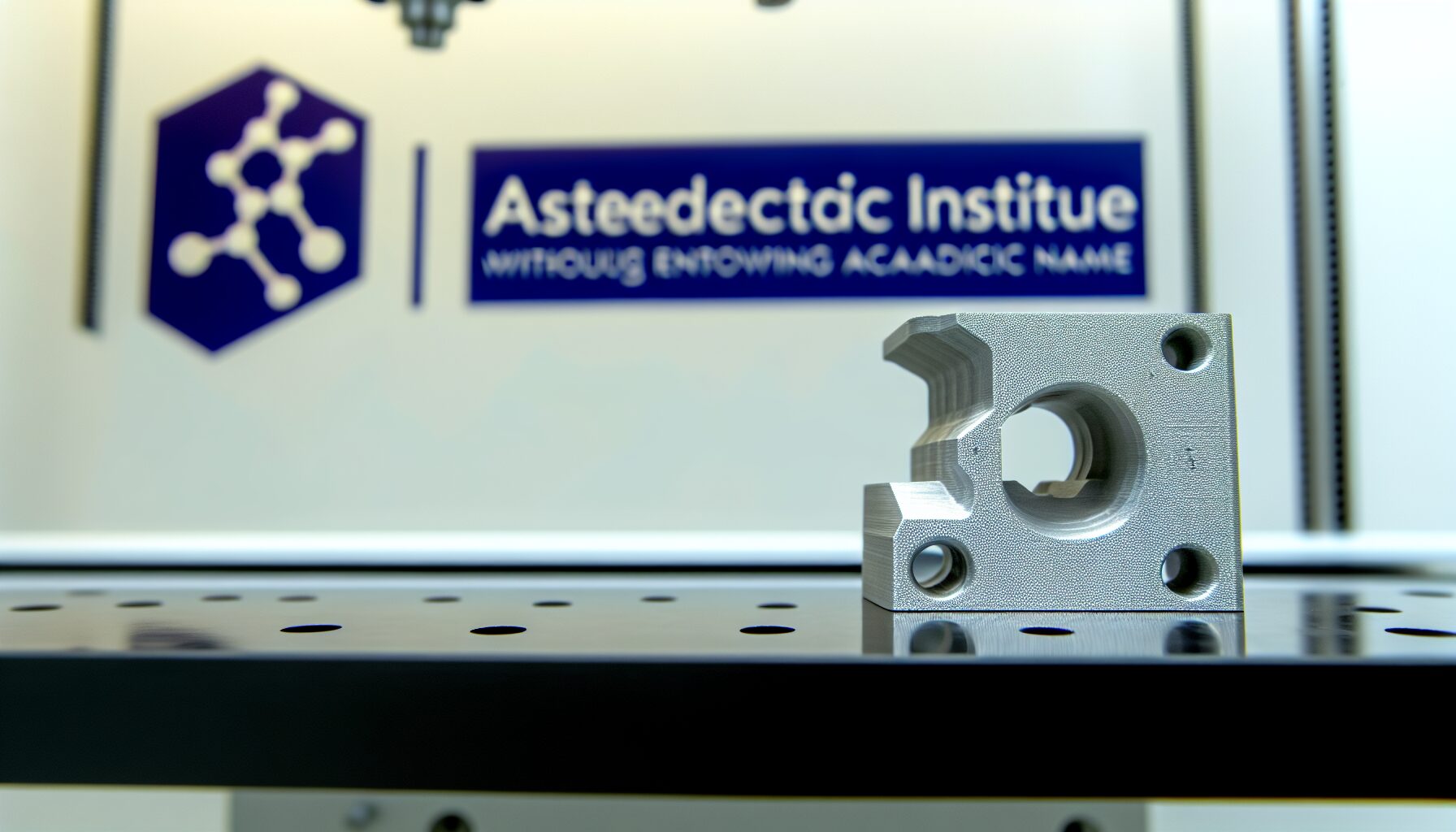
Researchers at MIT have unveiled a groundbreaking 3D printing technique that dramatically enhances the strength of aluminum, a material widely used in industries ranging from aerospace to automotive. By manipulating the metal’s microscopic structure during the printing process, the team has managed to make aluminum up to five times stronger than its conventional form.
3D Printing Innovation Enhances Aluminum Strength
Aluminum is prized for its light weight and corrosion resistance, but its relatively low strength has limited its use in high-stress applications. The MIT team, led by Professor A. John Hart and graduate student Yuchen He, tackled this challenge by using additive manufacturing to control the metal’s microstructure at the nanoscale.
Specifically, they focused on introducing nanoscale grains into the aluminum alloy during the laser powder bed fusion (LPBF) process—a common metal 3D printing technique. These grains act as barriers to dislocation motion, a key mechanism of deformation in metals. The result is a material that is significantly stronger without sacrificing ductility.
How the Process Works: Laser Powder Bed Fusion and Nanostructuring
Laser powder bed fusion involves spreading a thin layer of metal powder and selectively melting it with a high-powered laser. As the metal cools and solidifies, its microstructure is formed. In traditional LPBF, aluminum tends to form large columnar grains, which are less effective at resisting deformation.
To overcome this, the MIT researchers introduced zirconium nanoparticles into the aluminum powder. These particles act as nucleation sites during solidification, promoting the formation of equiaxed (roughly spherical) grains instead of columnar ones. The result is a fine-grained microstructure that significantly boosts the material’s strength.
“We’re showing that you can use additive manufacturing to not only shape a part, but also to control its microstructure,” said Professor Hart. “This opens up new possibilities for designing materials with tailored properties.”
Applications in Aerospace, Automotive, and Beyond
The implications of this research are far-reaching. Stronger aluminum could lead to lighter, more fuel-efficient aircraft and vehicles, as well as more durable components in consumer electronics and industrial machinery. Because the process is compatible with existing LPBF systems, it could be adopted relatively quickly by manufacturers.
Moreover, the technique could be extended to other metals and alloys. The concept of using nanoparticles to control grain structure during 3D printing is not limited to aluminum. This opens the door to a new class of high-performance materials engineered at the microstructural level.
“This is a significant step forward in materials science and additive manufacturing,” said He. “We’re excited to see how this technology can be applied in real-world products.”
Background: The Evolution of Metal 3D Printing
Metal 3D printing has evolved rapidly over the past decade, moving from prototyping to full-scale production in industries like aerospace, medical devices, and energy. LPBF is one of the most widely used techniques, offering high precision and the ability to create complex geometries.
However, controlling the microstructure of printed metals has remained a challenge. Traditional manufacturing methods like forging and rolling allow for grain refinement through mechanical working, but additive manufacturing builds parts layer by layer, limiting such options. The MIT team’s approach represents a novel solution to this problem, using chemistry and thermal control to achieve similar results.
What’s Next for 3D Printed High-Strength Aluminum?
The researchers plan to further refine their technique and explore its scalability. They are also investigating how different nanoparticle additives and printing parameters affect the final properties of the material. Collaborations with industry partners are likely as the technology moves closer to commercialization.
In the long term, this innovation could lead to a new generation of 3D printed materials with properties tailored for specific applications—stronger, lighter, and more efficient than ever before.
Source: ScienceDaily

