
MIT’s 3D Printed Metamaterials Spread Damage, Improve Impact Resistance
MIT and Northeastern have created 3D printed metamaterials that spread impact damage, offering new options for stronger printed parts.
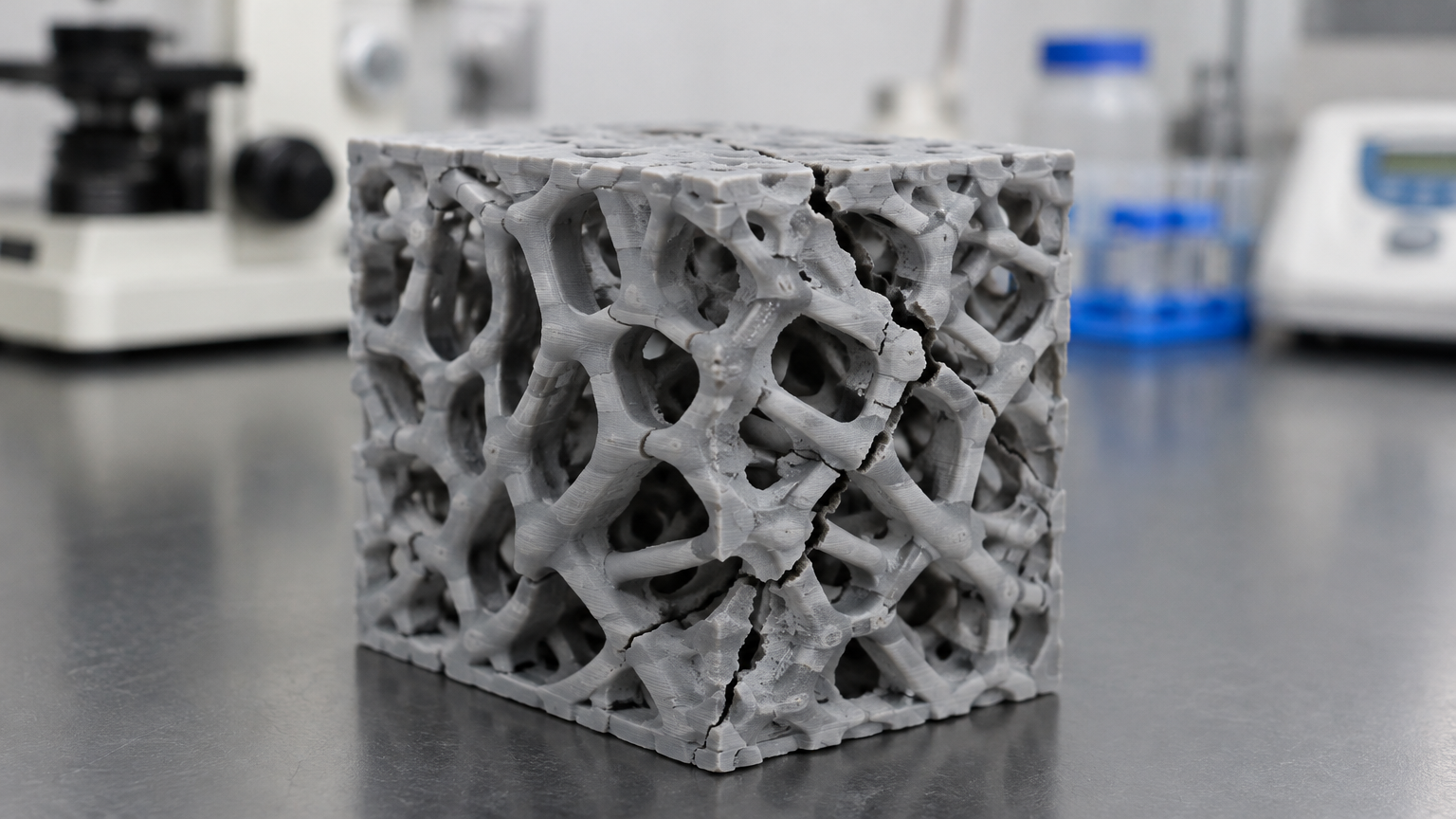
Recent research from MIT and Northeastern University has introduced a new class of 3D printed metamaterials that distribute impact damage over a wider area, making printed parts more resistant to crushing and catastrophic failure. According to 3D Printing Industry, these “scale-rich” metamaterials use a network of beams of various sizes instead of repeating identical cells, resulting in improved energy absorption and reduced risk of sudden collapse. This new approach could have practical implications for anyone using 3D printing to create functional, load-bearing or impact-resistant components.
Key points
- MIT and Northeastern have created 3D printed metamaterials with disordered, multi-scale beam networks.
- These materials spread out impact damage by 37% compared to conventional lattices, according to 3D Printing Industry.
- The approach could improve the safety and reliability of 3D printed parts in engineering applications.
- The full impact on home and workshop printing remains to be seen, as the technique is currently demonstrated in research settings.
What are scale-rich metamaterials?
Traditional 3D printed lattices and honeycomb structures rely on repeating geometric cells. These designs are often chosen for their predictable mechanical properties: they can be tuned for stiffness, weight, or energy absorption by adjusting the size and shape of the repeating unit. However, when a lattice is damaged—by impact, compression, or fatigue—the failure tends to concentrate along certain lines or nodes, leading to rapid, localised collapse.
The new scale-rich metamaterials developed by MIT and Northeastern researchers take a different approach. Instead of uniform repetition, they build a network of beams with a wide range of sizes and lengths, arranged in a disordered, non-repeating pattern. This architecture was 3D printed in polymers and then tested in compression and drop-weight experiments.
According to 3D Printing Industry’s coverage, the key result is that these materials spread damage 37% more widely than conventional lattice or honeycomb designs. Rather than a crack or failure propagating quickly through a single weak point, the energy of an impact is dissipated across many paths. This makes the material less likely to suffer catastrophic, sudden failure.
How does this compare to existing 3D printed materials?
For makers and engineers, the most common way to add strength to 3D printed parts is to use denser infill patterns or thicker walls, or to select a stronger filament type. Lattice structures, such as gyroids or honeycombs, are popular for lightweighting and improving energy absorption. However, most slicer software (see our slicer software guide) offers only a limited set of repeating infill patterns, and almost all are regular and periodic.
The MIT approach fundamentally changes this by using disorder and a hierarchy of beam sizes. In theory, this can make a part both stiff and tough, allowing it to absorb impacts without failing suddenly. The idea is similar to how bone or natural materials handle damage: instead of breaking cleanly, they allow microcracks to form and spread, dissipating energy and giving warning before total collapse.
While some advanced slicers support custom infill or lattice generation, the kind of multi-scale, disordered networks described in the research are not yet a standard option. Creating such structures may require specialised software or custom scripts, and the effectiveness will depend on the printer’s ability to resolve fine details and on the mechanical properties of the chosen filament. The research used polymers, but did not specify which materials or whether the effect holds for common home-printing plastics like PLA or PETG.
What does this mean for 3D printing at home or in small workshops?
The immediate impact of this research is likely to be felt in high-performance applications, such as aerospace, automotive, or protective gear, where energy absorption and failure resistance are critical. However, the underlying principle—using structural disorder and multiple scales to improve toughness—could eventually filter down to desktop 3D printing.
For hobbyists and small businesses, several questions remain:
- Software and design: Most slicers do not yet support generating disordered, multi-scale lattices natively. Adopting this technique would require new plugins or third-party tools.
- Printer capabilities: Achieving the fine details of these beam networks may be challenging for FDM printers with standard nozzles. Resin (SLA/DLP) printers, with their higher resolution, may be better suited.
- Material properties: The study focused on polymers, but did not specify which types. It is uncertain whether the same improvements would be seen with commodity filaments or only with specialised engineering plastics.
- Practical use: The improved damage tolerance could be valuable for drone frames, protective cases, sports equipment, or any part likely to suffer impacts. However, more research is needed to translate the lab results into printable, real-world designs.
If open-source tools or slicers begin to offer “scale-rich” infill options, makers could experiment with printing parts that are less likely to fail suddenly under load. Until then, the main takeaway is that moving beyond regular, repeating patterns may open new possibilities for stronger, safer 3D printed objects.
What is still unknown?
Several aspects of the MIT and Northeastern research remain to be clarified before this approach becomes mainstream:
- Material compatibility: Will common filaments (PLA, ABS, PETG) benefit as much as the polymers used in the experiments?
- Printability: Can typical hobbyist printers handle the fine, multi-scale features without clogging or accuracy issues?
- Design generation: Will software tools emerge that let users easily generate these structures from standard STL or CAD models?
- Mechanical trade-offs: Does spreading damage come at the cost of lower overall stiffness or strength, and how does that balance play out in different applications?
As with many advances in metamaterials, the leap from research to practical use is not immediate. But the principle of spreading damage—rather than letting it concentrate—offers an intriguing new strategy for anyone designing 3D printed parts that need to survive real-world impacts.
For those interested in understanding more about how 3D printed structures have evolved, our history of 3D printing guide covers the milestones that led to today’s innovations.
Sources
- MIT’s 3D Printed Materials Keep Damage 37% More Spread Out, Mitigating Collapse - 3D Printing Industry
- MIT’s 3D Printed Materials Keep Damage 37% More Spread Out, Mitigating Collapse - 3D Printing Industry (Google News)
This article was written with AI assistance, based on the sources listed above.