
HP Promises Metal 3D Printing Technology Announcement in 2018
HP is a huge company; well-regarded in the PC, notebook, and printing industries with over $48bn in revenue last year. Recently, HP have expanded into the 3D printing market too, rolling out their Multi Jet Fusion range of printers. This week, they have taken this a step further. They’ve now announc
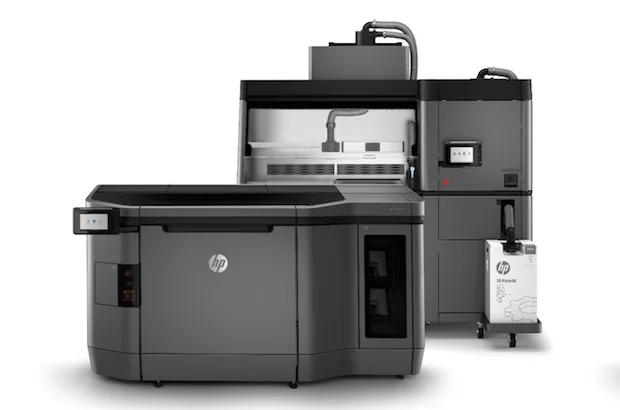
HP is a huge company; well-regarded in the PC, notebook, and printing industries with over $48bn in revenue last year. Recently, HP have expanded into the 3D printing market too, rolling out their Multi Jet Fusion range of printers. This week, they have taken this a step further. They’ve now announced that in 2018 they will expand and sell metal 3D printing machines as well.
A Unique Metal 3D Printing Platform
Speaking to IT industry analysts, HP confirmed it aims to start selling an affordablemetal 3d printing platform in 2018. The company did not clarify whether HP Metal 3D Printing technology will be an evolution of its current MJF 3D printing process or something entirely different, other than saying that it will be unique process based on proprietary technology.
As more and more technologies- both polymer and metal – are converging toward an integrated a powder-bed fusion/binder jetting/material jetting process, it is likely that the technology will follow along these lines.
What is Multi Jet Fusion?
Multi Jet Fusion itself combines powder bed fusion and material jetting processes. Desktop Metal integrates some features from MJF’s speed into its binder jetting process. Others, like XJet, are integrating metals directly into material jetting through metal and ceramic nanoparticles, for a process that – like binder jetting – requires post process firing. voxeljet’s HSS, on the other hand, implements a process which directly fuses polymer particles, after binding them. The main question is whether HP metal 3D printing will be a more direct PBF process similar to SLM or indirect like Desktop Metal’s (and ExOne’s and Digital Metals’) binder jetting. We think it will be the latter.
Mainstream Metal 3D Printing
HP has developed a “novel 3D metal approach,” Stephen Nigro, president of HP’s 3DP business, said at the HP Securities Analyst Meeting in Palo Alto, calling it a major step for HP 3D printing aspiration. While 3D metal printing is now available for more specialized, high-value products, Nigro said HP’s innovations will transform Metal 3D Printing into more mainstream, high-volume production.
Nigro also told analysts that HP in 2018 intends to bring to market full-color 3D printing, however that was already known and – if anything – represents a minor set back as most in the industry probably expected full color to be available sooner, in a release schedule that HP has otherwise fully delivered on so far. That said, when color becomes available, HP will be the only 3D printing company on the market offering mechanically robust and fully functional full-color parts.
As 3D printing becomes a tool for scale production, it becomes critical that these designers and creators have the ability to prototype using the same technologies and materials as will be used in full-scale production, and this is exactly what HP is aiming to accomplish with its moves forward. As always, each move HP makes is part of a larger puzzle of progress, a step toward a long-term, big-picture vision.
This was not the only announcement however. HP also stated they intend to offercolour 3D printing at a much lower price point. The aim with this is to allow smaller businesses to use the technology.
While HP has been displaying color 3D printing for some time, we have not yet seen what they can do with metal; today’s announcement is in line with the company’s initial announcement of entering the 3D printing industry a few years ago, without a great deal of specifics, but enough talking points to show that they mean business and are actively in development. No specific timeline came with today’s introduction of the plan to 3D print with metals, nor any information on price point, metal material capabilities, fusing techniques, or name for the metal process.
Even without much in the way of detail quite yet, Nigro is enthusiastic in pointing to their work with metal as being..
“another defining point for the industry” and notes that listeners should “stay tuned for more details in 2018.”
The Cost?
HP were less vocal however about the price these printers will retail for. We are assuming these will be expensive – their current plastic printers start at over $130,000 for the HP Jet Fusion 3D 3200. This is however cheaper than their rivals in this market, according to HP. Metal 3D printing will therefore not be accessible to the masses until significant advances are made. Their market is big manufacturers.
But will this expansion revive HP and its suffering sales? We will have to see if HP can deliver on its mass-production promises and become successful. If they can achieve this however, this marks a huge step in the advancement of 3D printing. If a 3D solution could rival traditional mass production methods for speed and cost, this would signal a new age of production.
The interview with HP’s CEO can be watched here.
How important do you think metal printing is to 3D printing? Let us know in a comment below and subscribe to our newsletter to get the latest 3D printing news straight to your inbox!